Tag: Feminism

29th Down Under Feminists Carnival

Down Under Feminists Carnival Logo

Welcome to the 29th Down Under Feminists Carnival.  Thank you everyone for your submissions which I have organised as much as I can.  I hope you enjoy reading these posts as much as I did, and that you continue to submit posts to an awesome carnival.  Thank you so much to Chally, of Zero at the Bone and FWD/Forward and Radical Readers and Feministe for organising this carnival and letting me host it.

Thank you to Chally, Jo, Mary and Deborah for hunting down and finding most of the great posts to include this month.  Thank you to everyone else who submitted their or other’s writings.

If I have used incorrect pronouns to identify any of the participants please let me know so that I can correct them.  Any misuse is unintentional and due solely to me being unfamiliar with the author of the post.

If I have misrepresented/badly summarised your post, please let me know and I’ll correct it.

So, this carnival is big and full of fascinating reading.  I hope you enjoy reading it as much as I enjoyed putting it all together.

This month’s optional theme was Awesome Women.

So, put your feet up, down, sideways or however you feel comfortable and enjoy.

Awesome Women

Ilaeria blogged about the three people who have had the biggest impact in her life, her mother and two grandmothers and share the lessons she learnt from them.

tigtog writes about Bell Hooks week at Hoydon About Town.  Deborah at In a Strange Land, during one of her Friday Womanist posts quotes Bell Hooks.

Deborah from In a Strange Land blogged about the anniversary of Sufferage for Women in New Zealand (17 September 1893) and the hard work that was put into gaining signatures for the petition that helped make is possible.

Mary at Hoydon About Town has been awesome and has developed a Firefox bookmarklet to make submitting blog carnival posts easier.  Please go and install so it is much easier to submit posts for the next carnival.

Media and society

Wildly Parenthetical at Hoydon About Town talks about Sexting and Slut Shaming and how bad the Minister for Home Affairs’s new campaign is for young women.

I spoke about Rampant Sexism in an edition of the MX where it suggested the women were different than men, that women should earn less than men for the sake of their heterosexual relationships and that women can steal men and that men can do nothing about it.

the news with nipples shreds an opinion piece in the SMH by Paul Sheehan.

Pickled Think writes about media and societal pressure on men to propose regardless of what their girlfriends may feel about marriage because it seems that their feelings aren’t important (all girls want to marry right?), and Pickled Think also discusses the patriarchal institution of marriage and the lack of the “big gay proposal”.  (The last line on the first comment is also gold).

Blue Milk demonstrates a little lesson in undermining women in power with thanks to the Courier Mail.

Blue Milk reviews Radical Act, a documentary about queer/feminist musicians in the USA, made in 1995

Ju at transcendancing has written a review of Glitter Rose, a short story collection by an Australian author doing interesting and challenging things with female characters.  The collection is published by a press that is also doing interesting and challenging things with a feminist focus in publishing.

Kim writes at Larvatus Prodeo about feeling sympathy for Stephen Conroy and the ongoing debate about the internet filter being more complex than liberties or the rights of adults.

Mary at Hoydon About Town wrote about #groggate and the outing of Grog Gamut’s legal name by The Australian.  The scary thing about The Australian’s justification is that they’re arguing for the outing of anyone who attempts to influence politics (or anything else) regardless of the wish for anonymity.

There are many ways that the less powerful are silenced, and conflating having something to hide or keep private with being not worth listening to is one of them, and insisting on identity disclosure is another. Not all pseudonymous writers are using pseudonyms to ethical ends, this is abundantly clear to anyone who has ever been on the Internet. But insisting that only those who name themselves and state their interest to everyone who lives in the country can speak is far worse.

Ariane at Ariane’s little world, adds to the discussion regarding #groggate by explaining that a person is not their job.
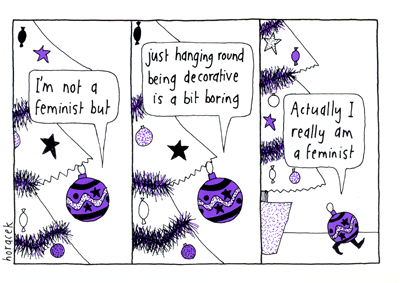
Image by Judy Horacek. Three panel cartoon of a Christmas decoration on a Christmas tree. The first panel reads, "I'm not a feminist but", the second "just hanging round being decorative is a bit boring", the third has the decoration walking away from the tree saying, "Actually I really am a feminist"

Bodies and health

Ariane calls bullshit on obesity being the root of all evil and society’s with  focus on fatness as a health issue.  Ariane also points out the negative health consequences of dieting.

Maia at The Hand Mirror discusses the politics of food and how our diet (what we eat) has changed, how food manufacturers want to make a profit from food and the impact that has.  Maia also posts a thread about why she hates The Body Shop and how conflating health and moral good or health and beauty are wrongMaia also posted a great 101 post on food and “healthy food” and how that is a misnomer.

Split Milk talks about why she doesn’t want to engage in discussions about dieting and how important fat acceptance places are.

Many fat activists also identify as feminists and in my opinion the most important tenet that those two movements have in common is a core belief in bodily autonomy. Advocating for fat acceptance is about asking for freedom from oppression and prejudicial treatment.

Spilt Milk also guest posted at Feministe about Fat acceptance: when kindness is activism where she discusses how acceptance of your body and kindness to yourself are activism.

Mimbles at Mim’s muddle writes about being fat and visible and includes links to posts that she’s found (some of which are in this carnival).

Michelle at The Red Pill Survival Guide writes about being fat and how societal sanctioned abuse of fat people is harmful.

You know what? Fuck you. You’re not me. You’re not that other person. You don’t know the circumstances surrounding why someone is the way they are unless they tell you. Yes, we all make superficial judgements but does that give you the right to be abusive or phobic? No.

Fat Heffalump shared her paper that she presented for the Australian Fat Studies conference this month.  She shares the effect that the “war on obesity” has had on her and most likely has had on others.

Sam at fat dialogue writes about her experience with Control Top Underpants and how important making people uncomfortable is as a really powerful critical and political intervention.

Julie at the Hand Mirror writes about Thin Privilege and how it isn’t all that great.

The Thin versus Not Thin dichotomy is yet another false division that just sets women against each other.  We need to fight, together, against a culture which judges us on our physical appearance, whether that appearance is one that conforms or not.

Steph writes at LadyNews that although Christina Hendricks is great, and the media acceptance of her not typically represented body type is also great, having her body shape/type as one to aspire to is not a good thing.

Pickled Think shreds an article discussing a new sitcom hopefully not coming to a screen near you, and how fat really isn’t coming back to Hollywood.

Health and disability

Jo at Wallaby writes about Accessibility and Sydney’s public transport, focusing on Sydney’s buses.

Michelle at The Red Pill Survive Guide (*trigger warning – discussion of suicide*) writes about World Suicide Prevention Day on 10 September, and talks about how she understands that level of despair.

Chally at Zero at the bone, writes about taking a sickie and how hard it is for people with disabilities to take a “sickie” for legitimate reasons let alone “bludging”.

Helen at FlyingBlogspot.com talks about her ordinary and what she does to manage day to day.  Helen also discusses how her ordinary may change with a review of her medication and trying some new treatment.

Race and Racism

Hexpletive blogged about the NSW Parliament amending the NSW State Constitution to finally recognise indigenous Australians as the first people in the State.

I wrote a piece about Boat People and how it should not be an issue.

Queen Emily at An Army of Rabbits discusses the concept of whiteness and the difference between white in Australia and white in the USA.

Jo at Wallaby writes a post about an anti-violence march asking some very pertinent questions for you to answer before you read Blue Milk’s post below.

Blue Milk writes about the march in Alice Springs by Aboriginal men to “stop the violence” and the lack of media coverage about positive Aboriginal stories.

Steph at 天高皇企鹅远 writes about japan ken and barbie, how they’re in Japanese inspired clothing and not actually Japanese, leading to the fetishisation and exotification of non Western cultures.

Chally wrote at Feministe about one of her favourite bit of cognitive dissonance.

stargazer at The Hand Mirror wrote about how collective responsibility is not productive, and states that, “i still don’t accept that i have any responsibility to apologise for the actions of someone i’ve never met and have absolutely no chance of influencing.”

the news with nipples writes Another burqa blog post and reluctantly gives Sergio Redegalli some of her time while she discusses how wrong his latest “art” work is.  Then asks why the debate about burquas is still being controlled by people who do not wear burqas.

LGBTIQ

Blue Milk talks about how Stephanie Rice’s apology to queer people was not adequate and points out all the flaws in that apology very nicely.

Steph at 天高皇企鹅远 went to WorldCon and discusses her experiences with two panels, one on queer themes in SF, which she had to walk out of and the other chaired by a trans academic which was a far more positive experience.

PharaohKatt at Distinctly Disgruntled (*trigger warning – discussion of suicide*) deconstructs Bob Katter’s comments regarding the apparently non-existent LBGTIQ population in his electorate, the high rate of suicide of LBGTIQ people and Bob Katter’s comments about suicide on a Q&A segment.

Fire Fly at The Long Way Home writes about Queer Femmes of Colour and their multiple burdens of authenticity.

I think the dynamic is deeply conditioned by internalised queerphobia. Specifically, internalisation of the double standard that there’s a threshold of queerness that someone has to prove in order to be ‘really’ queer (when there’s no such threshold for heterosexuality).

Intersectionality

Maia at The Hand Mirror discusses a proposed bill in New Zealand which would re-criminalise street sex workers and how the relevant political parties have voted.

It is specifically targeting street sex workers. Street sex workers do not generally have $2,000 to pay a fine. The fines, when they’re awarded, won’t have the magic power to stop someone being poor and working as a sex worker, it’ll just make them poorer. It won’t make street sex work disappear, it’ll just make it harder, more dangerous, and more marginalised.

Steph at vegan about town discusses how veganism, race and ethnicity intersect and how calling for China to be “wiped from the face of the earth” for the way they treat animals is hypocritical when every country mistreats animals.

Maia at The Hand Mirror also discusses how there is a connection between problems the way food is discussed and the problems with way food is produced and looks at this under a feminist framework.

Shiny writes about how she is all out of cookies and isn’t going to give them to people who meet basic human standards of decency.

Callistra writes about safety and safe spaces, what they can be and how they are created.

Safety and feelings of safe spaces are also a place of sanctuary. It’s an intimately known quality, where so much discussion has already occured that the system can meet your needs. It means when you’re miserable and need company to listen to, you have friends who can answer that need. Or if you’re miserable and need to talk; you know you can have these needs met. It means if you need to sit quietly and absorb group energy, you can do so without worrying what others might think, say or do. I noticed this as being ‘a place where you can exist without struggle of identity’.

Callistra also writes about what connections are and how they contribute to safe spaces.

Writing at The Hand Mirror, anjum writes about women in minority cultures, who as feminists want to criticise and change the culture, but who fear that it will only give ammunition to haters in the majority culture.

steph writes at vegan about town regarding exclusionary language in the vegan and animal rights movement in Australia and how veganism and the animal rights movement are often seen as white/Anglo-Saxon, middle-class movements.

Life

A Touch of the Crazy shares her recent life experiences, reflections and the importance of getting lost when travelling.

Pickled Think writes about surviving the Christchurch earthquake and how she feels right now.

Blue Milk writes about breastfeeding and how she felt when she first started and how she feels about it now.

Hexpletive writes about the 9th World Indigenous Women and Wellness Conference she attended and presented at in Darwin and then goes on to discuss the other Conferences and Conventions that she is interested in for the remainder of the year.  I’m going to have to look some of these up.

Spilt Milk shares an experience of encountering penis graffiti with her young daughter and recounts Helen Barne’s Young Adult novel ‘Killing Aurora’, in which the protagonist draws vagina dentata graffiti in response to penis graffiti.

Spilt Milk wrote about her childhood comforter and how that was taken away from her, and now how the childcare centre her daughter goes to wants to take away her daughter’s teddy bear.

Queen Emily writes at An Army of Rabbits, two (related) things that never happened to her in Australia, specifically the assumption that she’d been to church followed by an exhortation to keep god in her heart.

General Feminism

Chally wrote about how social justice can also be about staying silent and doing what is right for you versus the wider world (this post could fit under most categories, and I struggled to find the best fit).

Wallaby writes about how prioritising and choosing your energy drain is important for your wellness, and your choices in this regard should be admired, fostered and encouraged.

tigtog clearly states for the record why banning commenters and refusing comment publication is not censorship as blogs are privately owned spaces.

Women of Colour Australia has put a transcript up of their speech at NOWSA 2010.

the news with nipples writes about the petition put together by Plan Australia to make September 22 the International Day of the Girl.  You can sign the petition here.

Natalie at definatalie.com writes about her feral leghair and why she’s going to grow it.  She includes a great discussion about The Gruen Transfer and their discussion about redefining femininity based on advertising.

steph discusses at LadyNews the current Jadelle (a contraceptive implant) furore in the media.  steph advocates choice and education for women, which some of the quotes in the article also supported.

Megan at Craft is the New Black writes about the need for the ‘generations’ of feminism to recognise and celebrate each other’s worth.

In a post to mark Women’s Suffrage Day in New Zealand, Ele at Home Paddock writes of the need for us to exercise our hard won right to vote in the upcoming local body elections.

Violence

*Trigger warnings – posts in this section discuss violence against women*

The Dawn Chorus discusses Street Harassment and how when reporting it or writing down what has been said, the tone of what was said is missing which is one of the reasons why street harassment is often belittled or dismissed.

Blue Milk explains that asking is sexy and that without consent it isn’t sex and the comments are great too.

I don’t know why the idea has persisted that asking for consent is necessarily a clinical business – what is stilted about – more? do you want to? do you like? Because “mood-killer”? Are you kidding me? That moment when they close the space between you both and ask you to put your cards on the table – is this on or not, can I do this with you – is one of the most heart-flippingly exciting moments in all of existence.

Jo at Wallaby wrote about the treatment received by two women who had been sexually assaulted in different legal systems and how much those legal systems differed.

XY writes about why he won’t be walking in Reclaim the Night/Take Back the Night march and provides and excellent resource (if you need one) to explain to some men why they are not always welcome to march.

stargazer at The Hand Mirror writes about the governmental response to the task force for action on sexual violence and sadly how this seems to have been missed by the media.

AnneE at The Hand Mirror takes some relevant material from a paper on people who abuse their partners.

blue milk at Hoydon About Town writes about the strange behaviour of the state and society when a mother whose daughter was victim of incest is upset and protective of her daughter when pornography is displayed at a 7-11.

And isn’t it a strange world where police can be called in to protect your right to display pornography? So unquestioning are we about it that the newspaper article actually describes what unfolded as a “bizarre incident”. It is the same strange world where it is estimated that up to one in four girls will be sexually abused during their childhood.

Both Deborah from In a Strange Land and I wrote about Brendan Black and his opinion piece in Fairfax media on breastfeeding and breasts.  Unfortunately he fails terribly at being a feminist ally when he could have done very well.

Jo at Wallaby suggests that men should not go out alone otherwise they might, “be accused of, and/or commit, indecent assault, sexual assault, rape or other sexual violence.”

Related Posts:

Well this is disturbing

Well actually I think its incredibly creepy, and I don’t think I’m alone in that assessment.  So, the article was published in the Age, but taken from mashable.com – which I don’t read and today cannot be bothered investigating further.  I’ll use The Age article for basis and go on rambles from there.

What happens when you mix male gamers, pretty girls, and a social platform where girls that connects the two for a price? The answer is GameCrush, which has just opened to the public.

GameCrush first made headlines in March when it entered public beta. The site hooks up “Players” (mostly nerdy males) with “PlayDates” (mostly young females) to play everything from Call of Duty to simple arcade games. Players can choose to play either Xbox 360 games or just a simple browser-based game.

Initially this does not seem all bad.  The idea of “Play Dates” sounds nice, like something you’d take your children along to and getting people together to share common interests is a good way to meet people.  But only if it were that simple.  The article continues.

Users of GameCrush have four basic options for making connections with PlayDates. … The Edge is this service’s version of a red-light district.

There is a catch, of course. PlayDates don’t crush their controllers for free; it costs $US0.60 per minute to have a pretty girl sniping with (or at) you.

So there is a “red-light” district AND even just to play with “pretty girl[s]” you need to start paying.  And this is where it is creepy – in effect this is purchasing time with someone, making their time, attention and their appearance a commodity.  Which is pretty much what prostitution is.  It still gets worse:

And before you ask, yes, you’ll find girls that are willing to do more than just play games if you ask nicely. Part of the reason for this is the service’s points system; Players are expected to tip points to PlayDates, who can then trade them to get real cash. Simply put, there’s a big incentive for PlayDates to “do more” to earn more points.

While reading this I kept thinking of “gentlemen’s clubs” where for extra you can get private lap dances or private shows… and where some women will go further depending on the venue.  Is this really that much different?

Male geekdom already has big issues with the way women are viewed and this is not helping that at all.  The whole “Play Date” thing would be nice, if money weren’t exchanging hands and if the mostly female participants were not likely to be pressured to go further than just playing a game.  Sadly this type of enterprise just continues adding to the women are objects and can be owned, especially when you get to pay for them.

Related Posts:

This is NOT yours

*Trigger warning – this post mentions sexual assault*

An article in today’s Age, titled, “Grow up men!  Breasts are not public property” reminded me of a post that I had intended to write on being female and being public property.

But first let’s start with this article.  Despite being titled with “Breasts are not public property” the picture associated with the article is a depersonalised woman (shot of cleavage down to waist) wearing a low-cut leopard print top.  The first fail.

You could be forgiven for thinking that the image choice was made by a sub-editor, but as my husband is nearing the end of a 4 week stint as the Screen Play journalist at Fairfax while the regular journalist is on leave, I suspect the author, Brendan Black, chose that image himself because adding images to the online CMS is the journalist’s (well in my husband’s case) responsibility.  Even if it isn’t, the article’s incredibly sexist tones would suggest that Brendan Black did not fight against having that image placed there.

The next fail is a result of this:

Breasts are celebrated as an extremely erotic area of a female’s body, and males are all too happy to assert any apparent ownership rights to them. We love to sneak a peek at a woman’s cleavage, cop a feel when we’re allowed to (and even when we’re not), and have pride if our partners are “blessed” (as long as other blokes don’t look at them). Some women will use them to actively gain male attention, while others will feel anger if we dare to acknowledge the existence of their breasts, while forgetting they also have a face.

I’m guessing that Brendan Black was attempting to be a feminist ally with this piece, but he fails at every turn.  The first sentence of the section I’ve quoted above talks about males asserting ownership of breasts, as if breasts were property to be owned… and since they’re on a woman’s body you can own her too.

Then he enters incredibly dangerous territory with, “cop a feel when we’re allowed to (and even when we’re not)” effectively condoning sexual assault as being ok, because you’re only touching a woman’s breasts and they’re public property anyway, or property of her boyfriend/husband.  Lesbian’s breasts must be public property as must those of single women… yeah… or something because they don’t have a man who is claiming ownership of them.

Apparently heterosexual men will also be proud of their partner’s breasts if they are “blessed” without defining exactly what he means by blessed… having two breasts perhaps?  And then goes back into standard ownership territory with “as long as other blokes don’t look at them”.

Brendan finishes this section with a dig at feminists and women who don’t want to be harassed by men staring or groping their breasts by suggesting that it is not preferred that women would like to be more than their cleavage.

The next fail is:

Once my son was born, I quickly realised what I had long dreaded: my wife’s breasts had to be shared with someone else, even though he had a greater need for them than me. … Nevertheless, seeing my wife’s naked breasts several times a day, even with lessened ownership rights and in a new context, is still enjoyable, as it beats asking for permission.

So Brendan is back on the ownership stuff.  I’m sure Brendan doesn’t actually feel this way, but the way he is writing about his wife, it sounds like her breasts are far more important than the rest of her.  She sounds like she is a vessel to carry around breasts that he likes TM.  I actually struggle to believe that he really typed “lessened ownership rights” in a piece that is meant to be taken seriously, except I keep seeing it there, and it keeps making me more and more angry.  Brendan is speaking as if his wife is his property, that she has no agency, no thoughts of her own, that she is an inhuman object to possess like a car or a dog.  She has no dreams, wishes, ambition, likes, dislikes or passions.  She is just breasts and a feeding machine for their son.

Brendan actually gets to the point of the article after this section and talks about studies about breastfeeding and societal attitudes towards it… and by societal attitudes, I mean Western attitudes, and probably white-Western attitudes.

“The transition from sexual to sustenance object can create confusion in the minds of us mere males; we want to look because we like breasts, but as their raison d’être has been stripped of all sexual connotations in this context, we feel that we shouldn’t, and this can create embarrassment or disgust.”

I’m not sure at this point whether Brendan is summarising from the study he has quoted earlier or elucidating on his own, but he seems trapped in a world where breasts are sexual objects over their biological function.

When sitting near other breastfeeding mothers, I have wondered at my own feelings of embarrassment, given my pro-breastfeeding, pro-funbag stance, especially if I know the mother well.

Yes, he used “funbag” to discuss breasts in an article ostensibly about breastfeeding (and ownership of women).

If sexual relations recommence during the breastfeeding period, one would assume that the breast has not lost any of its sexual potency, even if its function has widened, its appearance has changed or discomfort has increased; a baby suckling at the breast is not akin to sharing your bed with an unwanted man with equal access rights.

I’m not sure that Brendan really understands the point/s he is aiming for in his article.  It’s like he’s suggesting that breasts are why heterosexual men have sex with women.  Without breasts they’re isn’t sex or something… and perhaps even that breastfeeding mothers can still be sexual women, which would be nice if it were phrased that way.

And then he dives right into “an unwanted man with equal access rights” which suggests to me that he has potentially likened his newborn son to being like another lover for his wife before realising that that is nonsensical.

Whatever the method, bottle or breast, the act of feeding and sustaining a child must override any selfish feelings we have regarding a woman’s body, whether in private or public. My own feelings of embarrassment have now dissipated, as I have reconciled that breasts have different uses, they need not be in constant battle with each other, and there’s no need to be a hypocrite. If a breast “on display” is there with an attached baby, chances are the mother is more concerned about her baby’s survival than giving you an eyeful. The sooner we realise that the world and the breasts in it are not there purely for our enjoyment, the better.

Yes, override any “selfish feelings” you have.  Let me reiterate my earlier point.  A woman’s breasts are her own and not yours.  Brendan has also finally learnt that breasts have different uses… not really.  Breasts are for breastfeeding, they have auxiliary uses if that works for the woman concerned.

Overall Brendan failed miserably here at being a feminist ally, and I think he was hoping to head that way with the last two sentences of the article.  His focus on ownership of his wife’s breasts, his casual acceptance of sexual assault by non-consensual touching of a woman’s breasts and complete failure to treat an important issue seriously leads to a big fail.

Women already have to deal with being viewed as possessions enough in the world without it being reinforced in an article like this.  Slavery ended over 150 years ago, and yet women are often still viewed as possessions or public property.  Some men feel that they have the right to look, touch or comment on women’s bodies and appearance without invitation or permission.  Telling them to smile, “complimenting” them while they’re going about their own business, and invading their space and bodies without permission.

It’d be nice if those men would stop and think about what they’re doing, but since they’re stuck in their sense of entitlement and strong belief that they have every right to demand that women respond to them.  But seriously guys?  This is my body, my space, my thoughts and dreams and you are not welcome to mess with them, because violence will ensue as I kick your arse.

Related Posts:

Rampant sexism in Friday’s MX (10 September 2010)

Colour me surprised and everything… who thought I’d find rampant sexism and plain bad journalism in the Herald Sun’s tabloid afternoon news paper… but I did and I thought, why not blog about it with my OODLES of spare time (hah!).  For what it is worth, one of their journalists wrote an opinion piece dismissing the article discussing gender roles being linked to biology (thank you so much Amelia Grevis-James).

So onto the articles which upset me. I’ll find equivalent links to either news.com.au articles on the same topic, or other relevant news sources as I discuss each article that offended me.

Sin? Your biology made you do it  (Maria Bervanakis)

This article is so NOT newsworthy that it was not run by news.com.au nor any other actual news source (I cannot find it on google news at all).  Instead, the best source I can find for it is Newswise from August this year.  Maria tells us that:

A study by a church-backed uni found that biology has a major role in sinful behaviour.

US Professor of Psychology and Neuroscience Matthew Stanford, of the Baylor University in Texas, examined years of research into people that commit the seven deadly sins and discovered their actions could be explained by their physical make-up.

What the article in the MX doesn’t say, which is reported in Newswise, is that Professor Stanford himself is religiously aligned, which is evident in the use of “sin” if you think about it.  The Newswire also doesn’t report of Professor Stanford actually has any qualifications in biology other than his qualifications in Neuroscience, and indeed where he obtained the qualifications he holds.

Newswire reports:

Stanford said all of the behaviors outlined in the book violate, in some way, the creative order that God has established, yet something biologically occurs in us that causes the behavior. However, biology is not destiny, Stanford said, and when we fully understand the effects of sin on our physical bodies, it becomes clear that “broken biology” can never be used as an excuse for sinful behavior.

As Stanford studied the data, he also noticed that, on average, men and women sin differently. Stanford said men tend to be outwardly manifested and focused on obtaining immediate gratification like aggression or adultery. The sins of women, on the other hand, tend to be more inwardly focused and concern on relational status, privilege or position like envy or pride.

“Because God created men and women physically different, it is understandable that the effect of original sin on our bodies and minds varies between the sexes,” Stanford said. “This is not to say that men and women differ in their degree of sinfulness, but simply that they sin in different ways. Men and women are equally sinful and sin is equally destructive in both.”

Each of these paragraphs should be addressed, although briefly because I don’t want to give this whackjob more time than he’s already had.

  1. Professor Stanford has published a book.  I haven’t read it, I’m not going to read it, and quite frankly am not interested in reading a book regarding what someone views as “sin” when I don’t share his religion.  To suggest that sin has any “effects on our physical bodies” without actually being clearer and providing examples (yes I know this is a summary report) and then saying that “‘broken biology’ can never be used as an excuse for sinful behaviour” comes across more as homosexuality is a sin and even if being gay is biological it is still a sin and you can control your behaviour.
  2. Look, men and women are different so they act differently and sin differently.  Quite frankly Professor Stanford, go fuck yourself and attend some Feminism 101 before ever saying such crap again.
  3. Look sinfulness is destructive (though it all depends on what you view as wrongful behaviour – according to Prof Stanford I’m a terrible sinner and would never get to heaven) and it impacts on women and men differently because they are different.  Seriously Professor Stanford, go and meet some actual real people and find out how similar (apart from societal conditioning) men and women actually are.

Wife’s pay can cost a marriage (unattributed)

This article was also run The Times of India, I can find no other news source in Australia that ran this piece.

Apparently, if a woman in a heterosexual relationship out-earns her male partner, that relationship breaking up is far more likely than in situations where a woman under earns her male partner. From MX:

The finding is the result of a 25-year study of more than 2500 marriages and follows other research showing that house-husbands are prone to affairs.

The US researchers found that women who consistently made more money than their husbands were up to 38 per cent more likely to divorce than others.

Jay Teachman, of Western Washington University, said possible reasons for the statistic were that financial independence makes it easier for women to escape an unhappy marriage, and dented egos – of both sexes.

For a happy marriage, Teachman recommends a 60/40 split in income, with the husband being the higher earner.

Thank you Mr Teachman for suggesting that women continue to earn less money than men and therefore have less money as a safety net to retire on.  Thank you Mr Teachman for proposing that instead of finding a way to solve the problem you’ve identified by having society treat each partner’s contribution to the relationship as valid, that women just take lower paying jobs.  And you know what lower paying jobs typically are Mr Teachman?  Would you do them?

This issue has been covered repeatedly, even on news.com.au.  So here are some good links so I don’t have to reinvent the wheel, you can just read it yourself.  🙂

So it’d be nice Mr Teachman if you actually think beyond “let’s make the wimmenz earnz less” and into whether or not those relationships should have been saved, what societal changes need to be made so that if women out-earn men then nothing negative happens.

Payback for hubby theft (unattributed)

Matching article at the Vancouver Sun.

Now… last I checked if you were going to have an affair with someone, that other person had to be willing – otherwise we’re entering the realm of unconsensual behaviour – and the MX and the Vancouver Sun certainly do not suggest there was any question of consent.  The MX used terms like “theft” and “stolen” in this article, which implies that the husband in this case was an automaton and had no part to play in the affair he clearly was involved in.  So yes, it takes two to tango here and suggesting otherwise removes agency from the now ex-husband and makes him completely blameless.  I note that the Vancouver Sun did not use either “theft” or “stolen”.

I’m not going to debate the strange law that North Carolina has on it’s books here right now.

So thank you MX for continuing the sexism that is prevalent in the world right now.  You had a great opportunity to dispel sexism and make the world a better place, but no you decided to wander the easy path and screw women over again.  I appreciate it, I really do.

Related Posts:

Who gets to decide these things anyway?

Most of the internet will be rightly outraged at Dr New of the Mount Sinai School of Medicine and Florida International University and her “treatment” of pregnant women using “safe” (read dangerous with terrible side-effects) hormones in order to cure teh gay…  PZ Myers and Dan Savage have blogged about the pure evil that this whole thing is in relation to lying about the drug’s safety, ethics approval, experimenting on humans, etc.  I don’t want to go over that other than to say that if my mother had been convinced to take this drug when she was pregnant with me, I wouldn’t exist as I do now.  No more bisexual woman out to herd geek cats with the best of them.

What I want to consider here is the fact that someone came up with the idea that to be a “proper female” you shouldn’t “display an “abnormal” disinterest in babies, [not] want to play with girls’ toys or become mothers, and [not choose a] “career preferences” [which is] deemed too “masculine.”” (Quote taken from Dan’s blog and then amended)

Who gets to say which career paths are too “masculine”?  I thought, now that we’re in 2010 and have attempted as much as possible to win the whole equal pay in relation to employment that all career choices were open to women and none could really be defined as “too masculine”.  I know that there are career paths which are dominated by one gender with rare incursions (for want of a better word) by the opposite gender, such as childcare and nursing for women and truck driving and construction work for men.  Though I wouldn’t say that those career paths are actually gendered other than by history and the current status quo.

I do wonder what Dr New and her researchers deemed to be a masculine career preferences and why, in the age of enlightenment that we’re supposed to be in (as far as women’s alleged ability to access any job she’s qualified for) choosing a non-traditional job for women is a bad thing.  My biggest concern is that Dr New and her team are attempting to impose patriarchal ideals of womanhood and what is means to be a proper/successful woman without looking at the benefits that women have gained over the past century.  Without sitting down and asking themselves if the meaning of “man” and “woman” have changed in a positive way that benefits everyone, including any children they may choose to have. How much do they want women to regress?

Erasing diversity and introducing conformity in our population to fit some weird hetero-normative ideal of what it is to be a proper woman or a proper man lessens us all.  As a diverse population of straight, gay, lesbian, trans*, bisexual, intersex, queer and questioning individuals we all have strengths that compliment each other’s weaknesses.  As a diverse population with interests in different career paths, we keep the economy moving and bring different strengths to the workplace.

I want to see Dr New, and anyone else who thinks that using this drug to treat non-CAH female fetuses, disbarred from practising medicine and forced to attend diversity education before they can re-register.   Oh and the ethics departments who have allowed this human experimentation… same deal.

Related Posts:

Queen’s Birthday Honours List – Sausage-fest

I wasn’t going to blog this weekend or until after my exams are done, but then I read the Queen’s Birthday Honours List as printed in The Age (gotta love the sub-editor who failed to notice “brithday”) and was absolutely horrified by the lack of female representation in the awards.  On my visual count (and I counted a total of 653 awards approximately), only 28% of the awards went to women.  All categories had an appalling representation of women.  Just looking at the police force and armed services and you’d think that there were next to no women in those fields.  Women make up slightly over half of the population, why are women making up far less than half of the QUEEN’s birthday list?

My count is as follows:

Order of Australia
Companion (AC) in the general division

Total awardees – 5
No of women – 1

Officer (AO) in the General Division
Total awardees – 21
No of women – 5

Officer (AO) in the Military Division
Royal Australian Navy
Total awardees – 1
No of women – 0

Royal Australian Air Force
Total awardees – 1
No of women – 0

Member (AM) in the General Division
Total awardees – 136
No of women – 33 – 35 (two awardee’s gender could not be identified)

Member (AM) in the Military Division
Royal Australian Navy
Total awardees – 2
No of women – 0

Australian Army
Total awardees – 8
No of women – 0

Medal (OAM) in the general division
Total awardees – 303 (approx)
No of women – 118 (approx)

Medal (OAM) in the Military Division
Royal Australian Navy
Total awardees – 2
No of women – 0

Australian Army
Total awardees – 5
No of women – 0

Royal Australian Air Force
Total awardees – 4
No of women – 0

Australian Public Service Medal

Australian Public Service

Total awardees – 17
No of women – 5

NSW Public Service
Total awardees – 11
No of women – 1

Victoria Public Service
Total awardees – 6
No of women – 2

Queensland Public Service
Total awardees – 5
No of women – 2

Western Australia Public Service
Total awardees – 1
No of women – 1

South Australia Public Service
Total awardees – 3
No of women – 1

Australian Police Medal
Australian Federal Police
Total awardees – 2
No of women – 0

NSW Police
Total awardees – 8
No of women – 0

Victoria Police
Total awardees – 5
No of women – 1

Queensland Police
Total awardees – 6
No of women – 1

Western Australia Police
Total awardees – 4
No of women – 0

South Australia Police
Total awardees – 3
No of women – 0

Tasmania Police
Total awardees – 1
No of women – 0

Nothern Territory
Total awardees – 1
No of women – 0

Australian Fire Service Medal
NSW Fire Services
Total awardees – 11
No of women – 0

Victoria Fire Services
Total awardees – 9
No of women – 0

Queensland Fire Services
Total awardees – 3
No of women – 0

Western Australia Fire Services
Total awardees – 1
No of women – 0

South Australian Fire Services
Total awardees – 2
No of women – 1

ACT Fire Services
Total awardees – 1
No of women – 0

Ambulance Service Medal (ASM)
Queensland Ambulance Service
Total awardees – 2
No of women – 0

South Australian Ambulance Service
Total awardees – 1
No of women – 0

ACT Ambulance Service
Total awardees – 1
No of women – 1

Emergency Services Medal (ESM)
Queensland Emergency Services
Total awardees – 3
No of women – 0

Western Australia Emergency Services
Total awardees – 3
No of women – 0

South Australia Emergency Services
Total awardees – 1
No of women – 0

Commendation for Gallantry
Australian Army
Total awardees – 3
No of women – 0

Distinguished Service Medal (DSM)
Australian Army
Total awardees – 4
No of women – 0

Commendation for Distinguished Service
Australian Army
Total awardees – 8
No of women – 0

Bar to the Conspicuous Service Cross
Australian Army
Total awardees – 1
No of women – 0

Conspicuous Service Cross (CSC)
Royal Australian Navy
Total awardees – 6
No of women – 0

Australian Army
Total awardees – 9
No of women – 1

Royal Australian Air Force
Total awardees – 6
No of women – 1

Conspicuous Service Medal (CSM)
Royal Australian Navy
Total awardees – 3
No of women – 1

Australian Army
Total awardees – 13
No of women – 4

Royal Australian Air Force
Total awardees – 4
No of women – 1

Total awardees – 653 (approx)
Total No of women – 183 (approx)
Percentage representation – 28%

Related Posts:

Christianity and women and sex

This is going to be a really short post, but I have to share it after finding this blog post on the internets.  I don’t know who Mark Gungor actually is, apart from someone who claims some authority on Christian marriage and relationships… but after reading the blog post linked to above, I think he needs to start all over again, perhaps with proper education about relationships and statutory laws.

Relevant annoying and icky bits from his blog are below:

I’ll dispel the myth regarding the requirement of a huge emotional connection. Women, more often than men, get hung up on this one and think they have to have all these warm and fuzzy emotions to feel like they can get physical with their husbands. I’m not saying that you always have sex with no emotion or connection–that would not be a healthy relationship. But what I am saying is that sometimes sex can just be sex.

As I said, sometimes sex is just sex; it’s what you do when you are married. Just like cleaning the toilet is what you do to keep your house clean…and I bet you don’t have this great desire or huge emotional connection to scrubbing the porcelain! You do it because it needs to be done and that’s the way it is with married sex… it does need to be done! It’s the glue that God gave us to bond us to one another. The bible is very clear that it is your responsibility as a spouse.

Understand that there is no need for all this desire and emotion nonsense. Don’t feel badly if you aren’t overwhelmed by all the over-the-moon feelings and passion ahead of time. There is nothing wrong with you. If you can enjoy sex once you start and have a good time, that’s all that matters. Just break the mindset that you won’t do it unless you feel like it. Let not your hearts be troubled. Just enjoy the deal without all the fuss and worry over the desire and emotion. It’s actually a trap, that if you aren’t careful, you can get caught in and you, your spouse and your relationship will suffer. (Emphasis in original)

Some of the comments on this thread are horrifying.  One woman says she was sexually abused before her marriage and after marriage her husband was not affectionate and was resentful of the healing she had to do from the assault.  She claims that often sex was unemotional and she relived the sexual abuse, and had she known that she could have just been unfeeling about the whole thing, then it would have been ok.  I really didn’t know what to do when I read this comment apart from bang my head against the desk.

A lone atheist who has found the blog through a friend takes on almost all the Christian commenters and the author herself.  She calls out the rape apology present by clearly arguing that such expectations of “having sex when you don’t want to” apply only to women and actually is rape, which is illegal.  She discusses the difference between subservience and equality, and quotes the bible back at those who quote it to her, in good productive ways.  The comments that she participates in are AWESOME.  I’d suggest reading them just for what she’s written.

But this whole post is a big concern – apart from the fact that a marriage counsellor of some description is telling people to just lie back and think of … well something – because it’s aim is at women.  You would never see a man being told to just have sex with someone, even if they don’t want to, because its far harder to fake an erection.

The Christian commentators and author keep returning to the bible, and to their understanding of how relationships should work based on the bible, which is a bad place to start methinks.  Their thinking is narrow minded and flawed and because Christianity is inherently misogynistic, their attitudes towards women are terrible (and sadly so are the attitudes of some of the female commentators towards themselves), and the idea of equality of women in a relationship isn’t really considered.

Some of the male commentators said they liked to do things for their wives because it made their wives happy, but there was very little discussion about how they have sex with their wives when they don’t want to – because that isn’t going to happen.

There is a lot wrong with Christianity and women in Christianity and I could blog at length about it, but for now, I’m just going to headdesk at this post some more and then go to bed.

Related Posts:

Problematic Words: Bitch

This is the first in which may or may not turn out to be a series on words I have issues with.  I am aware of and support efforts in reclaiming language used against marginalised groups and bodies.  I support people’s identities and the words they use in describing themselves.  This is a post about words that others use and how they are used by others.

Ok, so bitch… lets break it down a little.  Initially the word was used to describe a female dog or female canine.  Dogs are lower life-forms (traditionally) than people and are belongings.  So to refer to a woman or another person as a bitch is a dehumanising exercise, they are now a lower life-form (not human) and are a belonging, whether yours (my bitch) or someone else’s (their bitch).

Its also used in a sex negative context as well, referring to women (and only women) as being like a “bitch in heat”, which suggests that women are uncontrollable when they want sex, much like female dogs.

Bitch is also used to describe certain types of behaviour, such as bitchiness and bitchy.  Typically this refers to back-stabbing, gossiping and other unpleasant behaviour.  Descriptions of this behaviour is also given to gay men, which suggests that gay men are acting like unpleasant women.

If you are “someone’s bitch” then typically this means that you are their belonging.  So if I refer to X as “my bitch” then they’re mine, dehumanised and property.  Not such a good way to describe someone.  However, I do understand, and do refer to my physical belongings, as bitch from time to time.  If something slips out of my hands and I’m frustrated, I’ll say, “Argh! You bitch”, but I’m actually referring to inanimate objects here. And because I don’t like to dehumanise people I’m not going to call someone a bitch.

The Harpies, refer to women sometimes just having to “Be A Bitch”, usually to men, when boundaries are overstepped and there is a need to be assertive or opinionated because the other is not paying attention to your subtext, body language or even polite words about going away.  They’ve written about such things here and here and elsewhere on their site.  I am all behind assertive behaviour and sometimes just having to be rude if that’s what it takes for you to be safe, happy or unharassed, but I still have issues with calling it “Being A Bitch” because I don’t think that that word should be used to describe a set of allegedly unpleasant behaviours which are clearly just being assertive or opinionated as you see fit.

But I’ve been thinking about men’s fear of women’s anger and power and the word “bitch.”

Bitch, bitching, etc.:  these are thrown at women all the time, for any minor “infraction,” from asking for parity in pay or pleasure to daring to stand up for yourself.  I have no doubt that those who use it mean to silence and intimidate women.  (From The Pursuit of Harpyness)

I’m all for telling people to “shut the fuck up” or to “fuck off” when they harass me on the street, on the internet or anywhere else.  If someone calls me a bitch for knowing my boundaries, knowing what makes me feel safe or for turning them down, then that’s their problem and not mine. I’m not going to go home and be upset about it overly, but I don’t think I’ll personally ever reclaim the word “bitch”.  I can be assertive, just like men are allowed to be, and that doesn’t make me a bitch.  I can be opinionated, just like men are allowed to be, and that doesn’t make me a bitch.

I think the word “bitch” is usually pulled out when women act in ways that we’re “not supposed to”.  We’re supposed to be submissive and easy to target.  We’re supposed to be soft, gentle and unassuming… and quite frankly all of that can fuck off.

Related Posts:

Movie Review: Kick Ass

The movie is ultra violent, something which disturbed me, because I’m not a fan of gore – though that could have been close to realistic levels and been far more ick – it was quite toned down.

That said, the movie had some fantastic social commentary nestled in there that only becomes evident once you sit back and start thinking about it.

Firstly, violence is clearly part of nurture and not nature. Hit Girl was brought up to be able to look after herself, kill, incapacitate and not be squeamish about such things.

Secondly, Hit Girl demonstrates that girls can do all the things that are typically the domain of boys, she is able to defend herself, fight to protect those she cares about, kill, incapacitate and swear. Despite her ultra-violent upbringing, she’s still human, loves her dad who clearly dotes on her and wants him to be proud of her – just like any other child regardless of gender.

That aside, the film is also incredibly sex positive. When Dave and his girlfriend eventually hook up and act like sexual teenagers, the film doens’t make that a bad thing. Dave’s dad is happy his son has a girlfriend and tells him so, without any lecturing about “saving himself for marriage” or other such nonsense. The opening scenes about masturbation being a normal part of life also reinforce the sex positivity of this film.

This isn’t a children’s film – and the rating clearly demonstrates that.

The language in the film might be confronting for those who stuff their ears full of cotton wool every time they walk outside. It was funny to hear a tween swear, and particularly a tween girl swear, but really they’re just words people.

Related Posts:

This is why we need relationship training

Today survey results from a study conducted by VicHealth for the Australian Federal Government, into attitudes regarding  violence against women.  The full reports and stuff from VicHealth are here, the ABC coverage of the report is here.

This is the first such survey since 1995, so its been a while since the last one and this survey covered a broad spectrum of the Australian population.  The disturbing findings (“challenges”) as listed in the fact sheet are below:

Fewer people in 2009 believe that slapping and pushing a partner to cause harm or fear is a ‘very serious’ form of violence than in 1995 (from 64% in 1995 to 53% in 2009).

So although the percentage of people who think that slapping and pushing a partner to cause harm or fear has dropped, it is still stupidly high.

22% of people in 2009 believe that domestic violence is perpetrated equally by both men and women compared with 9% in 1995.

This is better I suppose.  Domestic violence is perpetrated by both genders, even if one gender features higher in statistics of domestic violence, but the number is still low, meaning that men who are victims of domestic violence are unlikely to be able to get the help or validation they need.

34% believe that ‘rape results from men being unable to control their need for sex’.

This feeds back into rape culture and the fact that men shouldn’t be held responsible for their actions in relation to sex, because it is an overwhelming thing that just destroys their minds…. or something.  Seriously although someone may crave sex, they can just masturbate versus raping someone.

One in four people (26%) disagrees that ‘women rarely make false claims of being raped’.

To put this in perspective, 26% of the people surveyed believe that women cry rape for fun.  Seriously people what is wrong with you?  Why would someone falsely claim that they were raped by someone else?  This is such a damaging claim, it detracts from everyone who has ever been raped and forces victims to go further than they need to to prove that they have been raped.  This is one reason why so many victims don’t go to the authorities after they’ve been raped, because who would believe them?

13% of people still agree that women ‘often say no when they mean yes’ and roughly one in six (16%) agrees that a woman ‘is partly responsible if she is raped when drunk or drug affected’.

This again is pure rape culture. The one at fault for raping someone is the rapist, and not the victim.  Victim blaming does not reduce rape culture, does not help the victim and if someone says “NO”, then that’s pretty clear.  When I say “No”, I do not mean, “Please come by and rape me later, it’d be fun.”  Thankfully there are some good rape prevention programs being launched around the world.

One in five people (22%) believes that domestic violence can be excused if later the perpetrator regrets what they have done.

“Oh, I’m so sorry I punched you in the face and gave you a black eye.  I didn’t mean to fracture your eye socket, I was having a bad day.”

Does that work for you?  Do you feel better now about that black eye and fractured eye socket, having to wear makeup to hide the bruising?  Probably not.  Domestic violence should not be excused, it is assault, it is a crime and no matter how sorry to perpetrator feels afterwards, that does not excuse what they did.  You may choose to forgive them, but that doesn’t wipe the slate and make what they did acceptable.

Eight in ten people in the general community say it is hard to understand why women stay in violent relationships and more than half believe a woman could leave a violent relationship if she really wanted to.

Thanks to the Family Law Center I have the perfect answer to this (yay the internet!).

Simply asking the question “Why do women stay in violent relationships?” is blaming the victim. People don’t seem to ask nearly as often, “Why do men batter?”, a question which places the blame with the perpetrator. It is easy to blame the victims in battering relationships. Often, those outside the relationship will think that if she really wants to leave, she can. However, abuse is never the victim’s fault, and there are often many psychological issues affecting abused women and their ability to leave an abusive relationship.

Ok, so to take this back to the title of the post.  I’ve been a long believer in the fact that sex education in Australia is completely inadequate to prepare people for not just sex but also relationships with the people they’re having sex with.  Teenagers muddle along in relationships, possibly basing them on what they’ve read, other relationships they’ve witnessed (good and/or bad) and the media.  If the education system actually had proper discussions about types of relationships, what was good in a relationship and what could be bad or problematic, that alternate relationship styles (BDSM, polyamory, etc) were ok and that alternate sexualities were also ok, then suddenly we have a system that can start preparing children and teenagers to have good relationships.  If we throw in good communication skills; an understanding of why honesty is important with your partner; proper discussions of domestic violence and sexual assault; and discussions of STI testing, and we’ve moved to providing a world class educational model for the next generation.

If this is done well, then maybe we’d reduce the number of people who think that victims should be blamed, reduce rape culture and get that tricky issue of consent sorted out.

Related Posts:

Navigation